Sie sind hier: Skip Navigation LinksInstitut für Laboratoriumsmedizin, Klinische Chemie und Molekulare Diagnostik Wissenschaft & Forschung Protease-signaling in vascular disease and sterile inflammation

Coagulation proteases in vascular disease and sterile inflammation

​​​​​​Head of the working group: 
Prof. Dr. med. Berend Isermann

Our research aims to understand how coagulation proteases regulate disease processes through signaling pathways, particularly those mediated by protease-activated receptors (PARs). Beyond their classical role in hemostasis, coagulation proteases act as signaling molecules that influence endothelial activation, vascular inflammation, and tissue remodeling. We study these mechanisms primarily in the renal vascular bed, which provides a suitable model to study the interaction of endothelial cells with parenchymal cells. Yet, we also investigate processes relevant to the systemic vasculature and other organs. Below are five of our key research areas.

1 - Regulation of Thrombomodulin-Protein C and PAR Signaling

A major research focus is the thrombomodulin-protein C pathway and its role in regulating cellular signaling. When thrombin binds to thrombomodulin on the endothelial surface, it activates protein C, which subsequently limits further thrombin generation. In addition to its anticoagulant function, activated protein C (aPC) exerts important cytoprotective and anti-inflammatory signaling effects. Many of these effects are mediated through PAR-dependent signaling pathways, particularly PAR1. In contrast to pro-inflammatory signaling induced by thrombin, aPC largely promotes protective PAR1 signaling that stabilizes endothelial barrier function and limits inflammation. We study molecular structures of PAR1 mediating biased thrombin versus aPC signaling and of PAR homo- and heterodimers. These pathways link activation of the coagulation cascade to inflammatory and innate immune responses, including interferon-associated signaling programs, ER-stress and inflammasome in vascular and immune cells. Our work aims to understand how these pathways regulate cellular responses during vascular and organ injury and regeneration. These projects are funded by the DFG under individual grants or are a part of the SFB1423. Berend Isermann is on advisory boards of start-up companies developing drugs harnessing cytoprotective signaling of aPC (function therapeutics, Novapep). 

Regulation of cellular function by thrombin (IIa) and activated protein C (aPC)-mediated PAR-signaling. The complex of thrombin and thrombomodulin (TM) generates activated protein C (aPC). aPC and IIa induce biased PAR1 signaling and regulate cellular function (e.g., mitochondrial or endoplasmic reticulum function), with the effects being mostly opposite (cytoprotective versus cytodisruptive for aPC versus IIa, respectively).

2 - ERC Project: Tissue Factor–Driven Interferon Signaling

Our ERC-funded research evaluates how tissue factor modulates immune signaling by interacting with the interferon-receptor IFNAR1. Tissue factor is the main initiator of the coagulation cascade and is strongly induced during vascular injury and inflammation. We discovered an interaction of TF with IFNAR1: In this heterodimer, both TF and IFNAR1 are inactive. Upon cellular stimulation, this heteromer dissociates, activating simultaneously TF and IFNAR1. Thus, the TF – IFNAR1 heteromer is a singular molecular switch controlling directly thrombo-inflammation. We aim to understand how this heteromer is regulated, on which cells and in which disease conditions the TF – IFNAR1 thrombo-inflammatory switch is relevant, and aim to identify therapeutic approaches to modulate the TF – IFNAR1 heteromer.
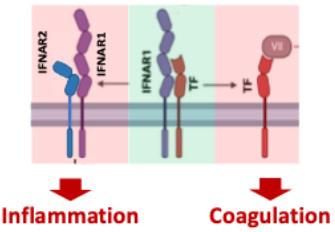
A novel thrombo-inflammatory switch: the TF-IFNAR heterodimer. On resting cells, TF and IFNAR1 form a heterodimer and both are inactive (green). Upon cellular activation, this heterodimer breaks up, IFNAR1 forms a heterodimer with IFNAR2, inducing IFN type 1 signaling upon lingand binding, and TF binds to fVII, initiating blood clotting via the extrinsic coagulation pathway and TF-dependent signaling.

3 - LeiCeM: Vascular Aging and Metabolism

​Within the framework of the Leipzig Center of Metabolism (LeiCeM), part of the German excellence initiative, we study how vascular aging and associated molecular changes such as hypercoagulability or inflammation drive metabolic alterations, obesity and organ dysfunction. We aim to understand how vascular aging drives metabolism driven diseases, such as obesity or kidney disease. In addition, in collaboration with the endocrinology clinic and other clinics and institute, we evaluate strategies to defeat weight re-gain post weight loss.

https://www.uni-leipzig.de/leipzig-center-of-metabolism

4 - EMILIA

Early Mechanisms of Lifestyle-Associated Vasculo-Metabolic Disease​

As part of EMILIA – Early Medical Training in Lifestyle-Associated Chronic Vasculo-Metabolic Diseases, we are promoting funding opportunities for medical students to conduct their research work. Within the EMILIA consortium, we investigate the early mechanisms that initiate lifestyle-related diseases, including obesity, diabetes, and cardiovascular disorders. Our focus is on the initial stages of disease development, where physiological adaptation begins to shift toward pathological processes. A key objective is to identify critical “switch points" at which vascular and metabolic homeostasis transitions into disease. By studying these early events at the molecular and cellular level, we aim to better understand how metabolic stress, inflammatory signaling, and vascular dysfunction interact at the onset of disease. Identifying such transition points may enable the development of early diagnostic markers and precision medicine approaches to prevent disease onset or slow disease progression at early disease stages.

https://www.uniklinikum-leipzig.de/wissenschaft-forschung/schwerpunkte-forschung/forschungsprojekte/emilia

5 - Experimental and Translational Approaches

Within the above listed projects, we combine advanced molecular and systems-level technologies. These include single-nucleus RNA sequencing (snRNA-seq) to resolve cell type-specific responses in vascular tissues, OLINK based proteomics and FRET/BRET-based biosensors to study protease and receptor signaling dynamics in living cells. We further apply epigenetic analyses, genetically modified mouse models, and studies in human cohorts to investigate these pathways in vivo and in clinically relevant contexts. In addition, Seahorse-based metabolic profiling allows us to examine how cellular metabolism influences endothelial activation and vascular inflammation. We interact with other national and international laboratories to supplement our know-how and methodological approaches.

Together, these approaches enable us to investigate how protease-driven signaling networks regulate vascular biology in health and disease.​


Five recent key publications

  1. ​Elwakiel A, Gupta D, Rana R, Manoharan J, Al-Dabet MM, Ambreen S, Fatima S, Zimmermann S, Mathew A, Li Z, Singh K, Gupta A, Pal S, Sulaj A, Kopf S, Schwab C, Baber R, Geffers R, Götze T, Alo B, Lamers C, Kluge P, Kuenze G, Kohli S, Renné T, Shahzad K, Isermann B. Factor XII signaling via uPAR-integrin β1 axis promotes tubular senescence in diabetic kidney disease. Nat Commun. 2024 Sep 11;15(1):7963.
  2. Zimmermann S, Mathew A, Bondareva O, Elwakiel A, Waldmann K, Jiang S, Rana R, Singh K, Kohli S, Shahzad K, Biemann R, Roskoden T, Storsberg SD, Mawrin C, Krügel U, Bechmann I, Goldschmidt J, Sheikh BN, Isermann B. Chronic kidney disease leads to microglial potassium efflux and inflammasome activation in the brain. Kidney Int. 2024 Dec;106(6):1101-1116. 
  3. Manoharan J, Rana R, Kuenze G, Gupta D, Elwakiel A, Ambreen S, Wang H, Banerjee K, Zimmermann S, Singh K, Gupta A, Fatima S, Kretschmer S, Schaefer L, Zeng-Brouwers J, Schwab C, Al-Dabet MM, Gadi I, Altmann H, Koch T, Poitz DM, Baber R, Kohli S, Shahzad K, Geffers R, Lee-Kirsch MA, Kalinke U, Meiler J, Mackman N, Isermann B. Tissue factor binds to and inhibits interferon-α receptor 1 signaling. Immunity. 2024 Jan 9;57(1):68-85.e11. 
  4. Rana R, Manoharan J, Elwakiel A, Zimmermann S, Lindquist JA, Gupta D, Al-Dabet MM, Gadi I, Fallmann J, Singh K, Gupta A, Biemann R, Brandt S, Alo B, Kluge P, Garde R, Lamers C, Shahzad K, Künze G, Kohli S, Mertens PR, Isermann B. Glomerular-tubular crosstalk via cold shock Y-box binding protein-1 in the kidney. Kidney Int. 2024 Jan;105(1):65-83.
  5. Gupta D, Elwakiel A, Ranjan S, Pandey MK, Krishnan S, Ambreen S, Henschler R, Rana R, Keller M, Ceglarek U, Shahzad K, Kohli S, Isermann B. Activated protein C modulates T-cell metabolism and epigenetic FOXP3 induction via α-ketoglutarate. Blood Adv. 2023 Sep 12;7(17):5055-5068.

Members


Current members:

Vascular aging and endothelial dysfunction
 

Dr. Ahmed Elwakiel
Post-doc 

Send Email


Dr. Rajiv Rana
Post-doc 

Send Email


Dr. Julia Buchold
Clinican Scientist 

Send Email


Zhiyang Li
PhD student 

Send Email


Pan Hu
PhD student 

Send Email


Antonia Pfeiffer
MD student 

Send Email


Jasper Lieckfeldt
MD student 

Send Email


Diabetic vascular complications
 

Dr. Kathleen Biemann
Clinician Scientist 

Send Email


Hailong Kong
PhD student 

Send Email


Intracellular signaling
 

Akash Mathew
PhD Student 

Send Email


Elias Pogander
MD student 

Send Email


Fides Möbus
MD student 

Send Email


PAR signaling
 

Dr. Hamzah Khawaja
PhD student 

Send Email


Shihai Jiang
PhD student 

Send Email


Dr. Josephine Jacoby
Clinician Scientist 

Send Email


Julian Sun
PhD student 

Send Email


Surinder Pal
PhD student 

Send Email


TF driven interferon signaling
 

Yuvrajsinh Gohil
PhD student 

Send Email


Eylül Akyildiz
PhD student 

Send Email


Yashwini Dewan
PhD student 

Send Email


Dr. Felix Förster
Clinician Scientist 

Send Email


Former members:


Jayakumar Manoharan
PhD student


Dheerendra Gupta
PhD student


Shruthi Krishnan
PhD student


Ishan Gadi
PhD student


Lukas Breitenstein
MD student


Thati Madhsudhan
PhD student, Post-doc


Sanchita Ghosh
PhD student


Satish Ranjan
PhD student


Juliane Wolter
PhD student


Hongjie Wang
PhD/ MD student


Moh'd Al-Dabet
PhD student​​

Paul-List-Str. 13-15, Haus T
04103 Leipzig
Telefon:
0341 - 97 22200
Leitstelle (24h):
0341 - 97 22222
Fax:
0341 - 97 22209
Map