UKL releases AMPEL platform as an open-source project
Source code, technical documentation, and regulatory expertise made available / Other hospitals can build their own clinical decision support systems
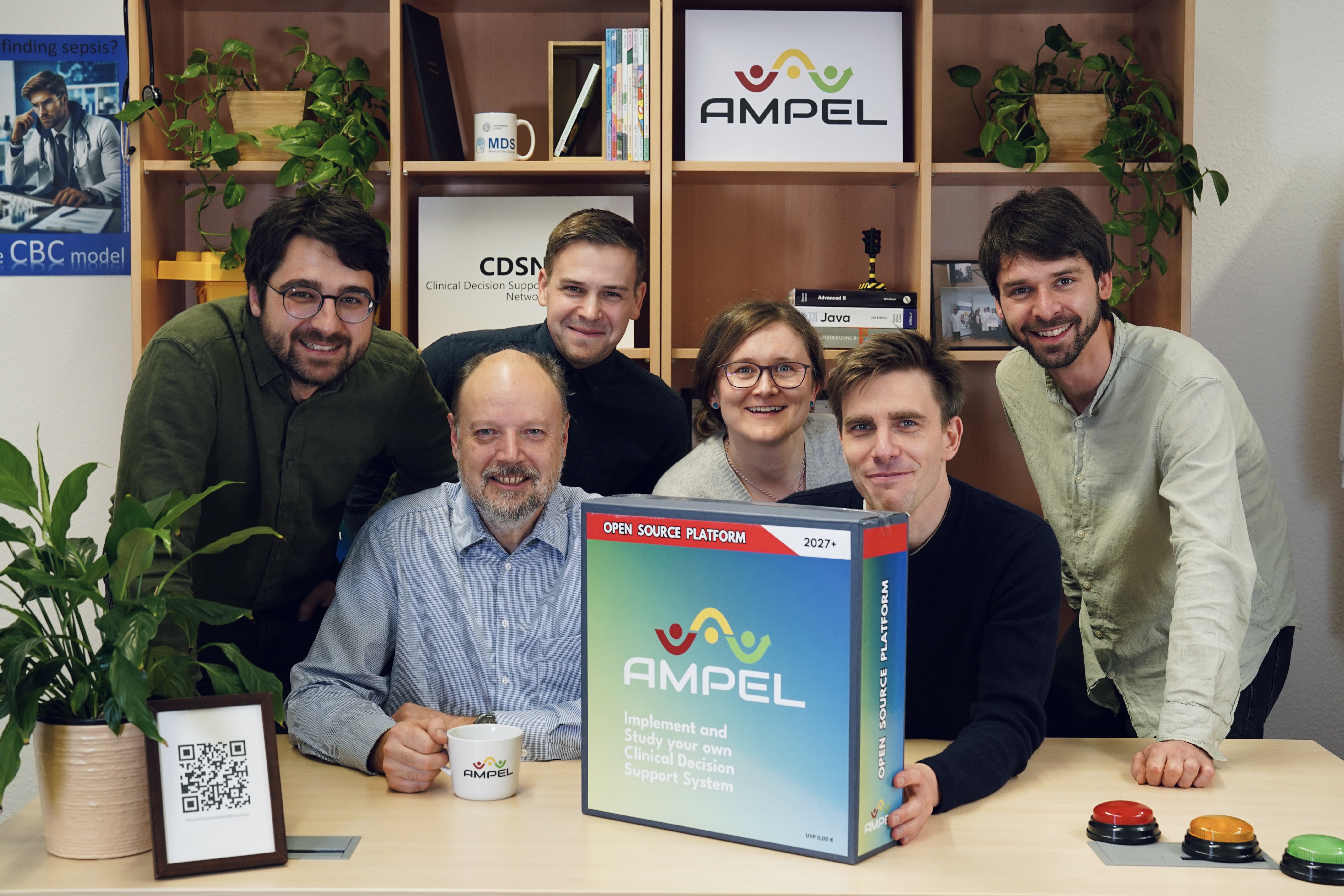
The team is pleased to announce the release of the AMPEL platform as an open-source project.
Leipzig. The University of Leipzig Medical Center (UKL) is releasing its AMPEL platform as an open-source project. This makes the source code, technical components, and extensive documentation available to other hospitals and research institutions. The goal is to make it significantly easier for others to build their own clinical decision support systems. Further development together with other university hospitals is already underway.
Clinical decision support systems such as AMPEL, developed at UKL, analyze digitally available patient data and alert medical teams to potential risks and previously undetected critical conditions. They improve patient safety, but do not replace a physician's diagnosis or judgment: The responsible care team always decides which additional diagnostics to perform and what treatment to provide.
The AMPEL platform has been developed and scientifically studied at UKL since 2018. It is the basis for LAMPE, the hospital's own medical device software, which is being used in routine care since April 2026. The system analyzes clinical data in real time and can, for example, flag the risk of acute kidney injury during antibiotic treatment. Further applications, such as the early detection of sepsis or refeeding syndrome, are planned.
“The AMPEL platform is the result of a long development process: What began as a local application in laboratory medicine has today become an interdisciplinary infrastructure for patient care," says Martin Federbusch, head of the Department for Clinical AI and Translational Medicine (MedKIT) at UKL.
The UKL is providing more than just software components with the first ever open-source release of such a platform in Europe. The release also includes a location-independent technical reference documentation. Institutions will be able to use this basis for the development of their location-specific software for use in patient care, in accordance with the requirements of the Medical Device Regulation. An online wiki summarizes all information in the form of technical and regulatory manuals. Two scientific publications provide further details on the regulatory approach and technical architecture.
The open approach makes the platform's functionality verifiable by experts and offers a transparent alternative to the black-box products typically used. Hospitals can also adapt the components to their own needs, develop them further, and share their experience with the community. At the same time, the project aims to shorten development and implementation times and enable the incorporation of publicly funded preliminary work.
“We are releasing AMPEL to encourage other institutions to participate in the platform. Clinical decision support is an interdisciplinary field. Although we have made substantial progress in Leipzig, the platform can only reach its full potential as a community project," says Dr. Daniel Steinbach, head of the AMPEL platform and deputy head of the MedKIT department.
Cross-site development is already underway. Together with Dresden University of Technology and University Hospital Carl Gustav Carus Dresden, the team is investigating how AMPEL can be adapted to another hospital infrastructure. An implementation at University Hospital Schleswig-Holstein is also planned for 2027. The MedKIT department established at UKL will oversee the platform's long-term maintenance and further development.
More information about the AMPEL platform and the open-source project:
https://www.uniklinikum-leipzig.de/einrichtungen/ampel/
Regulatory publication (preprint): https://doi.org/10.48550/arXiv.2611.30858
Technical publication (preprint): https://doi.org/10.48550/arXiv.2611.30990
Source code and documentation: https://github.com/ampel-platform/ampel
Please note: The AMPEL platform itself is not a medical device under the MDR. Further information and disclaimers.