UKL establishes its first in-house AI software as a medical device for patient care
Another step toward digitalization / AMPEL project leads to the development of a decision support system / Invitation for nationwide collaboration
Leipzig. The University of Leipzig Medical Center (UKL) is integrating an in-house developed AI-based Clinical Decision Support System (CDSS) called “LAMPE” into patient care. Thsi is the first time that a CDSS has been developed at a German university hospital entirely in-house and in compliance with the strict requirements of the Medical Device Regulation (MDR). Unlike generative AI systems such as the recently established Company-GPT UKLGPT, “LAMPE” is used directly in patient care. With this first in-house development of an AI-supported medical device, the UKL is realizing another important component of its current digitalization strategy.
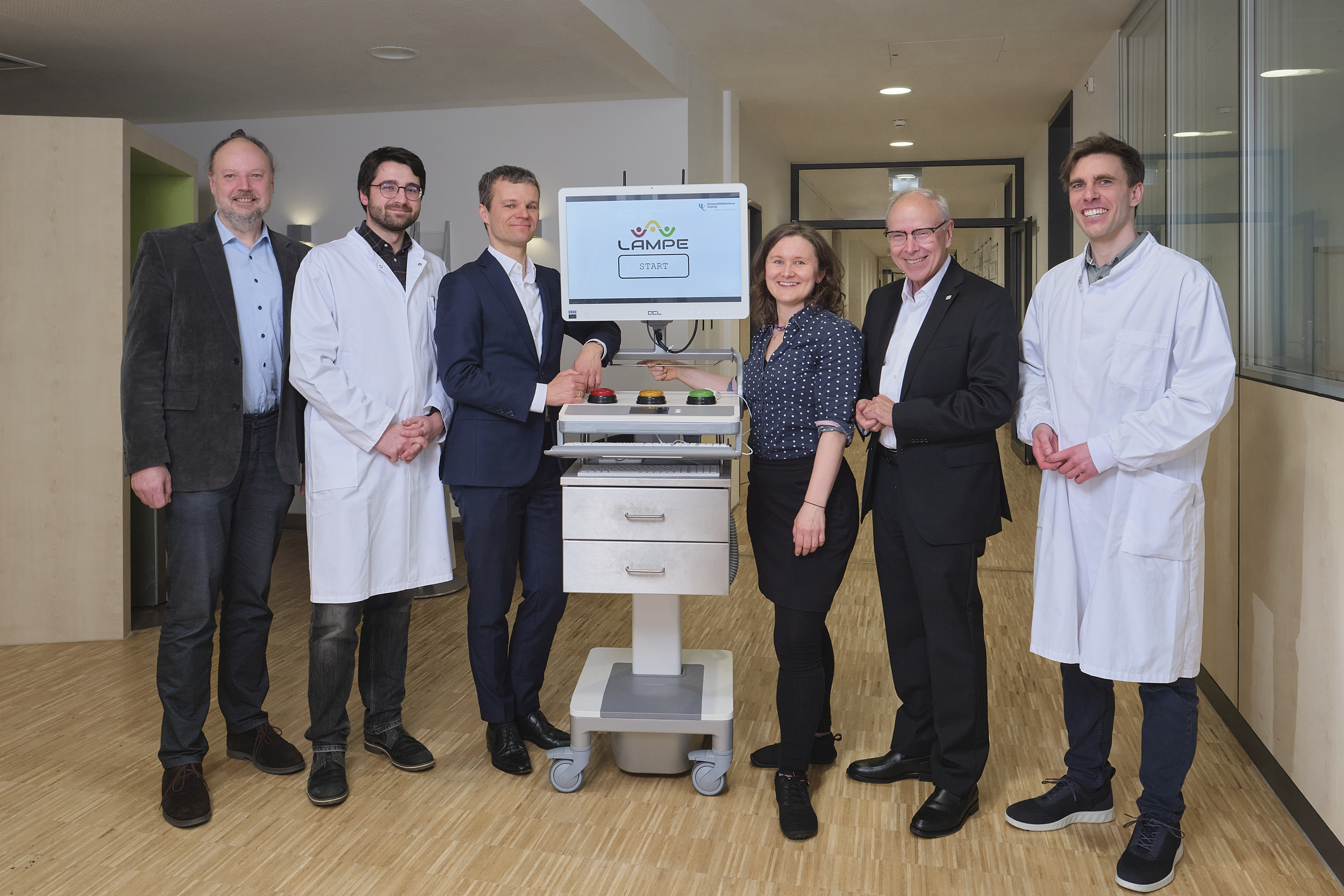
Together, they launched “LAMPE” (From left) Prof. Toralf Kirsten, Head of the Medical Data Signs Department; Martin Federbusch, Head of the MedKIT Department; Dr. Robert Jacob, Chief Financial Officer of UKL; Maria Schmidt, Scientific Director of the MedKIT Department; Prof. Dr. Christoph Josten, Chief Medical Officer of UKL; and Daniel Steinbach, Head of AI Development, MedKIT Department
As a Clinical Decision Support System (CDSS), the application assists physicians in making diagnostic and treatment decisions and also complies with the requirements of the European Medical Device Regulation (MDR).
Unlike generative AI applications such as in-house GPT systems, LAMPE is an evidence-based, clinically validated system that is directly integrated into treatment processes and supports specific medical decisions in everyday clinical practice through real-time data analysis. LAMPE is short for “Leipziger Analyse- und Meldesystem für Patientensicherheit in Echtzeit" (analysis and reporting system for patient safety in real-time).
“The greater the influence of digital systems on diagnosis and treatment, the more important it is that medical responsibility and decision-making authority remains within the clinical setting,” says Dr. Robert Jacob, Chief Financial Officer of the UKL. “Our first medical device development strengthens independence in clinical practice while also enhancing patient safety.” For the UKL, the decision to develop its own MDR-compliant AI software also marks a strategic shift: transparency, responsibility, and control over clinical decision support remain directly with the treating experts.
LAMPE is the result of seven years of research conducted as part of the AMPEL project, followed by thorough software development. The UKL has established new structures specifically for meeting the extensive regulatory requirements for medical devices. A central role in this effort is being played by the recently founded Department for Clinical AI and Translational Medicine (MedKIT), which brings together medical, scientific, and technological expertise. The necessary regulatory expertise is provided by the recently established UKL subsidiary for innovation transfer, MITCenter gGmbH.
“The hospital's IT department now has the opportunity for further development towards a more medically active department,” explains Prof. Toralf Kirsten, director of the Medical Informatics Center at UKL and professor of medical data science. “Through in-house developments like these, we can combine scientific findings with practical clinical experience and incorporate them more directly, and also significantly faster, into patient care.”
Early Detection of Kidney Failure
A current example of LAMPE’s application is an algorithm for the early detection of acute kidney failure in patients receiving antibiotic therapy. This algorithm was developed through close collaboration among several departments, including pharmacy, microbiology, infectious diseases, and laboratory medicine.
Through real-time analysis of clinical data and automated alerts, risks can be identified early and permanent damage reduced. In the future, the platform will be expanded to include new but also previously developed algorithms from the AMPEL project, including those for the early detection of sepsis or the identification of refeeding syndrome.
Innovation Through Responsability
With its in-house development approach, the UKL is blazing a new trail in the German hospital landscape. The goal is to maintain in-house control over key digital tools for patient care and to integrate innovations into daily clinical practice without delay.
At the same time, the UKL is consciously focusing on collaboration: The plan is to further develop the AMPEL platform—on which the in-house medical device production system LAMPE is based—as an open-source project and make it accessible to other university hospitals. In addition, the Clinical Decision Support Network (CDSN), which already connects more than 20 locations, promotes exchange and collaboration.
“We also see our development as a blueprint for other organizations," says Martin Federbusch, head of the MedKIT department. “Our goal is to significantly accelerate the development of comparable systems and to jointly strengthen the digital innovation capacity of university medicine.”
>News