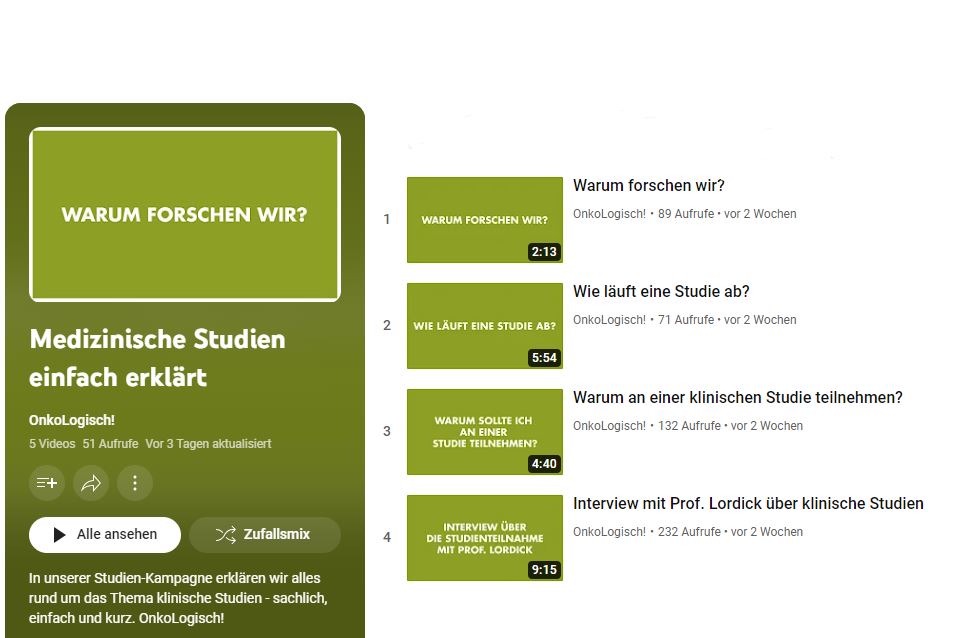
In our videos, you will learn why we conduct research in clinical trials, how clinical trials are carried out, and whether you can benefit as a study participant.
– Why do we conduct research?
– How does a clinical trial work?
– Why should I take part in a clinical trial?
– Interview with Prof. Lordick on participation in clinical trials
Clinical trials explained simply - YouTube
Cancer trials: Why do we conduct research?
We want to understand cancer better and better in order to achieve further improvements in cancer treatment with innovative therapies. In trials, many study participants are treated under the same conditions so that the benefit of new therapies can be reliably assessed. These trials are strictly monitored by authorities and ethics committees and may only be conducted by specially trained medical staff.
Video: Why do we conduct research?
How does a trial work?
In addition to studies that aim to improve understanding of the disease, there are interventional clinical trials, for example to test new medications. Before approval, these must go through three trial phases in order to objectively assess whether the new therapy is effective. In Phase I, a small number of patients are treated to determine the optimal drug dose. In Phase II, tolerability is examined, and in Phase III, effectiveness is compared with the standard therapy. Patients are usually assigned to the standard or experimental group at random, without participants or treating physicians knowing which group they are in. This is important to avoid influencing the results through expectations.
Video: How does a trial work?
Why should I, as a cancer patient, take part in a trial?
As a study patient, you are closely cared for by trained study nurses and your condition is carefully monitored during therapy. In some studies, you also receive additional examinations. The knowledge gained from studies benefits future patients and thus leads to continuous improvement in cancer treatment.
Video: Why should I, as a cancer patient, take part in a trial?
Prof. Lordick: “We know […] that patients who participate in clinical trials generally have better treatment outcomes than patients who do not. This is because within clinical trials we can offer very new, very innovative, very promising treatments that are usually not yet available outside of studies, and because we can care for and monitor patients within clinical trials very safely and very closely. One very important point is also: participation in a clinical trial is never mandatory. It is always voluntary.”
Video: Interview with Prof. Lordick
University Cancer Center Leipzig:
We research for you – research with us!