Sie sind hier: Skip Navigation LinksRudolf-Boehm-Institut für Pharmakologie und Toxikologie

Inhibitor-induzierte Gegenregulationsprozesse im Magenkarzinom: von sekundären Resistenzmechanismen zu neu akquirierter Tumor-Vulnerabilität

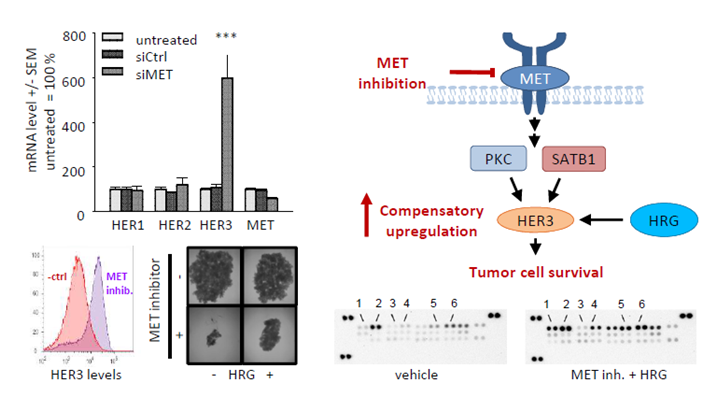
​​​​​​​​​​Das Magenkarzinom ist eine der häufigsten Krebsarten und Ursache Krebs-assoziierter Todesfälle. Während bei anderen Tumorarten zielgerichtete Inhibitoren zunehmend die klassische Chemotherapie ergänzen, blieb dies im Magenkarzinom klinisch bislang weitgehend erfolglos. Die Verbesserung der personalisierten Therapie bedarf somit der Identifikation von Faktoren, die für eine primäre oder sekundäre Resistenz verantwortlich sein können. Hier kann vor allem auch der kompensatorischen Hochregulation anderer onkogener (non-target) Rezeptortyrosinkinasen (RTKs) große Bedeutung zukommen. Diese kompensatorische Hochregulation mit daraus folgender (Über-)Aktivierung alternativer onkogener RTKs kann jedoch nicht nur eine Ursache sekundärer Resistenz gegenüber zielgerichteten Inhibitoren darstellen, sondern auch neue Therapieoptionen eröffnen.

So werden in diesem Projekt (i) Inhibitor- bzw. RNAi-/Knockdown-induzierte Veränderungen in der Expression onkogener RTKs umfassend charakterisiert, über Proteomanalysen weitere Kandidaten identifiziert sowie die zellulären und molekularen Effekte dieser Gegen-(hoch-)regulationen analysiert, (ii) daraus definierte Kombinationen spezifischer Inhibitoren/Knockdowns ermittelt und bzgl. additiver/synergistischer Effekte getestet, (iii) sequenzielle Therapie-Regime (sekundäre Resistenzinduktion als „acquired vulnerability") exploriert („second hit concept" mit etablierten Inhibitoren, inkl. möglicher Dosis-Reduktionen gegenüber Einzelbehandlung) und (iv) vielversprechendste Kombinationen bzw. sequenzielle Therapie-Regime an primären Tumoren über ex vivo-tissue slice-Kulturen von frischen Patiententumor-Resektaten validiert.​

zurück zur Übersicht Forschungsgebiete


​Projektpartner:

English Project Description

Inhibitor-induced counter-regulation processes in gastric carcinoma: from secondary resistance towards newly acquired tumor vulnerabilities

Gastric cancer is one of the most frequent tumor entities and a leading cause of cancer-related deaths. While in other tumor entities targeted inhibitors offer novel options in addition to classical chemotherapy, their clinical use in gastric cancer has remained largely unsuccessful so far. Despite promising preclinical data, the use of specific inhibitors against these targets has remained disappointing in the clinical setting. Thus, the improvement of personalized therapies requires the identification of factors responsible for primary or secondary resistance. In this context, the compensatory upregulation of other oncogenic (non-target) receptor tyrosine kinases (RTKs) may well be of major importance. Interestingly, this compensatory upregulation with concomitant (over-)activation of alternative oncogenic RTKs may not only be a major reason for secondary resistance. Rather, it could also offer novel therapeutic options.

On this basis, this project aims at (i) the in-depth characterization of inhibitor- or RNAi/knockdown-induced alterations in the expression of oncogenic RTKs, the identification of other candidates by proteomics and the analysis of cellular and molecular effects of these counter-(up-)regulation processes, (ii) the definition of promising combinations of specific inhibitors / knockdowns, for testing with regard to additive/synergistic effects, (iii) the exploration of sequential therapy regimes, based on the concept of secondary resistance induction as "acquired vulnerability". This „second hit concept" with established inhibitors may also include dose reductions compared to single treatment, (iv) the validation of most promising combinations and sequential therapy regimes on primary tumors, using ex vivo tissue slice culture models from fresh patient tumors.​​


Härtelstraße 16-18, Haus V
04107 Leipzig
Telefon:
0341 - 97 24600/24660
Fax:
0341 - 97 24609/24669
Map